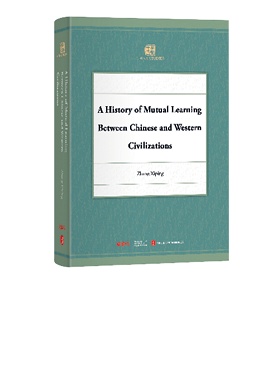
A History of Mutual Learning Between Chinese and Western Civilizations
Author: Zhang Xiping
Price: RMB 198
Hardcover, 532 pages
Published by Foreign Languages Press
As the rhetoric of a “clash of civilizations” once again becomes globally relevant, how we understand relations among different civilizations concerns not only historical interpretation but also the future of humanity.
Professor Zhang Xiping’s new book, A History of Mutual Learning Between Chinese and Western Civilizations, falls precisely within this contemporary context. A leading scholar of Chinese-Western cultural exchange, Western sinology, and the history of Christianity in China, Zhang is editor-in-chief of International Sinology and president of the International Society for the History of Chinese Language Education. His academic background gives the book both a solid documentary foundation and a broad theoretical vision.
The book focuses on the 300 years from 1500 to 1800, examining the encounter between China and the West during the late Ming (1368-1644) and early Qing (1644-1911) dynasties, within the historical process of globalization’s first dawn. Zhang proposes a core assertion: this encounter was not just a precursor to the later “impact-response” model, but rather a model of mutual learning grounded in a relatively equal footing, involving deep two-way interaction, and active contribution to each other’s modernization.
The book is divided into two parts: the first on “Western Knowledge Spreading to the East” and the second on “The Transmission of Chinese Learning to the West.” Its 12 chapters open like interconnected windows. It does not begin with the familiar figure of Italian pioneering missionary in the Ming Dynasty, Matteo Ricci (I552-1610); instead, it starts with the Strait of Malacca and the early Chinese maritime world. The Portuguese arrival in the East was accompanied by navigation, trade, colonial expansion, and collisions of state power. This reminds readers that the Chinese-Western encounter never occurred in a vacuum; cultural exchange has always been embedded in a real world of power, interests, and suspicion.
The first part of the book shows how Western knowledge entered China. It covers questions that include how missionaries understood Confucianism and whether it was considered a religion, a philosophy, or an ethical guide, from a Western point of view. It also examines why the Bible took different forms when interpreted by different missionaries.
Translation, the author points out, is far more than the mere substitution of words. Translators must judge, select, and even create concepts, while recipients understand and rewrite them according to their own intellectual traditions. Many words, categories, and ideas that later became commonplace took shape through such back-and-forth experimentation.
Zhang attaches particular importance to points where things do not coincide. In his account, misunderstanding is not a blemish to be erased from the history of exchange; it exposes the knowledge boundaries of different civilizations and is more likely to become the starting point for reinterpretation and creation.
The second part of the book devotes equal space to explaining “how Chinese knowledge traveled to the West.” The channels through which Europe came to know China were far more than just through Confucian classics. Maps provided spatial images of territories, cities, mountains, and rivers; materia medica and medical knowledge entered the fields of European natural history and medicine; and ethical maxims reached a broader readership in a relatively concise and accessible form. A distant and abstract “China” thus gradually became an object of knowledge that different classes and audiences in Europe could read about, view, discuss, and even debate.
Of course, this “China as read by Europe” was not China itself. What missionaries chose to translate, how they explained Confucius, how European publishers arranged materials, and what Enlightenment thinkers sought in Chinese institutions and ethics were all shaped by their own time and lens. The author does not simply ask whether these understandings were “accurate”; he asks why translated Chinese knowledge could function in Europe and how it participated in Europe’s self-reflection and transformation. This perspective changes the cultural transmission narrative to which we are accustomed. In this historical period, China was both a recipient and a provider of knowledge and ideas. Such a two-way observation restores the original complexity and agency to the concept of “exchange.”
For readers who wish to understand how civilizational exchange truly happens and how mutual learning between China and the West has shaped both sides, this work is essential reading.