From August 30 to September 3, 2026, Chinese President Xi Jinping traveled abroad to attend the Shanghai Cooperation Organization (SCO) Summit in Kyrgyzstan, while also paying a state visit to the host country, and then to Egypt.
Far from a routine sequence of diplomatic engagements, the trip offered a snapshot of how the Global Governance Initiative (GGI) China has proposed is evolving from a conceptual framework into robust institutional mechanisms, deeper regional cooperation, and concrete action.
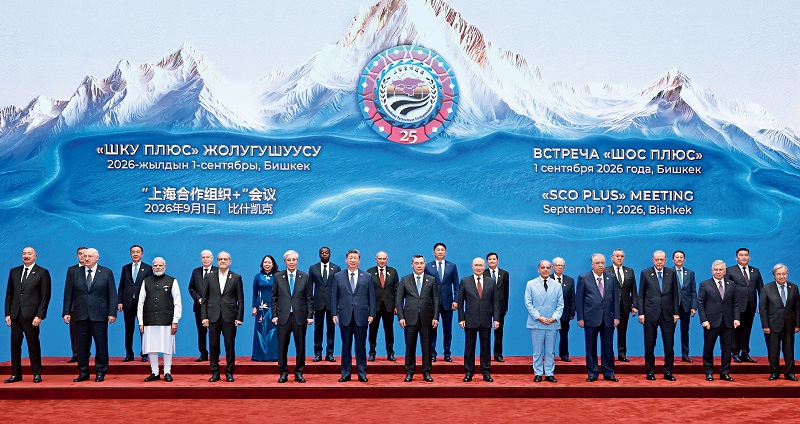
Chinese President Xi Jinping poses for a group photo with other leaders of the delegations to the SCO Plus Meeting in Bishkek, Kyrgyzstan, on September 1, 2026.
SCO: An Engine for Multilateral Governance Reform
Proposed by Xi at the SCO Plus Meeting in Tianjin in September 2025, the GGI outlines a clear roadmap for reforming and improving the global governance system. The initiative advocates a more just and equitable global governance system and community with a shared future for humanity, anchored in the five principles of adhering to sovereign equality, abiding by the international rule of law, practicing multilateralism, advocating a people-centered approach, and focusing on real actions.
One year on, the GGI has demonstrated that it is far more than a conceptual proposal, as it is increasingly being incorporated into international practice. The initiative has garnered support and positive responses from nearly 160 countries and international organizations, while more than 60 countries have joined the Group of Friends of Global Governance, providing a platform for closer coordination on global governance issues. Such broad participation reflects a growing international consensus that global governance must become more representative, inclusive, and responsive to the interests and aspirations of all countries.
The past year has seen the GGI move from principles to institutional practice. This is reflected in the inauguration of the International Organization for Mediation in Hong Kong in October 2025, creating a new mechanism for peaceful settlement of international disputes. In addition, the World Data Organization and the World Artificial Intelligence Cooperation Organization were established, opening new avenues for international cooperation in emerging areas where effective global governance is increasingly needed. These efforts demonstrate that improving global governance is not simply about articulating new principles, but also about building rules, setting up institutions, and delivering tangible results.
This evolution was particularly visible at this year’s SCO Summit. Addressing the SCO Plus Meeting on September 1, Xi said that the gathering focused on strengthening the role of the United Nations and building a multipolar world, and it demonstrated the SCO’s commitment to reforming and improving global governance as necessary in the modern era.
Xi articulated a clear vision for what this multipolar world should look like. Sovereign equality and mutual respect are fundamental principles; balance, order and the rule of law are inherent requirements; multilateralism, dialogue, and consultation are essential pathways; mutual benefit, win-win, and inclusiveness are the way forward for development.
Xi further called for guiding the reform and improvement of global governance through the SCO Action. Stressing that making the global governance system more just and equitable is the mission and responsibility of the SCO, he urged SCO members to stay committed to building partnerships rather than alliances, engaging in dialogue rather than confrontation, and upholding the principle of “planning together, building together, and benefiting together.”
Speaking at the 26th Meeting of the Council of Heads of State of the SCO on September 1, Xi emphasized dialogue, consultation, and more equitable, orderly governance. “We should always advocate that all countries, regardless of their size, are equal, and that regional affairs should be discussed by all countries to bridge differences and build consensus, properly handle differences through dialogue and consultation, and meet common challenges through multilateral collaboration,” he said.
In this sense, the SCO is becoming not merely a regional cooperation mechanism, but also an important platform through which the GGI’s principles can be translated into collective action. With the growing participation and voice of the Global South, the organization offers a practical vehicle for advancing greater representation, equality, and cooperation in international affairs.
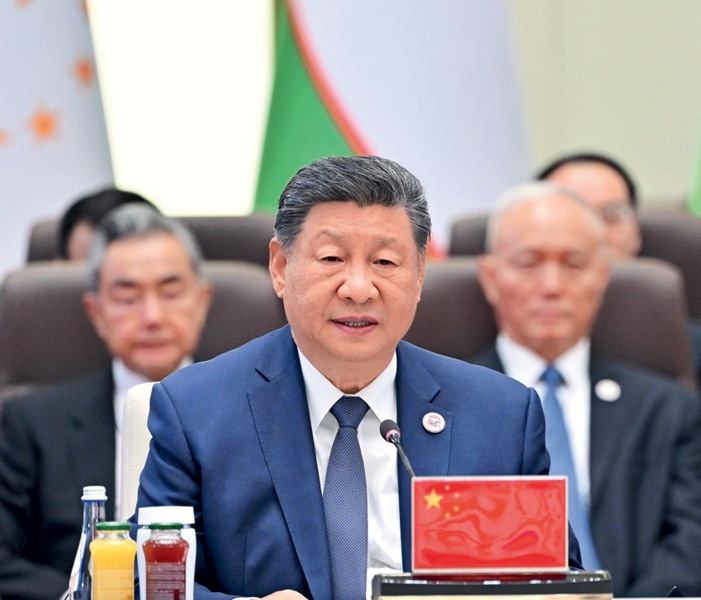
President Xi attends the SCO Plus Meeting and delivers an important statement titled “Jointly Advocating an Equal and Orderly Multipolar World and Making Global Governance More Just and Equitable” in Bishkek, Kyrgyzstan, on September 1, 2026.
Central Asia: Grounding Global Governance in Shared Prosperity
Xi’s recent state visit to Kyrgyzstan illustrated how the GGI’s principles can drive bilateral and regional partnerships. China-Kyrgyzstan relations have entered what Xi described as a “golden period” of rapid development, marked by growing political mutual trust and expanding practical cooperation.
In 2025, bilateral trade reached a record US $27.2 billion, up 19.8 percent year on year, reaffirming China’s position as Kyrgyzstan’s largest trading partner and source of foreign investment. Major projects such as the China-Kyrgyzstan-Uzbekistan Railway are opening new horizons for regional connectivity, while cooperation in electricity, healthcare, and education is improving people’s livelihoods. Meanwhile, people-to-people exchanges surpassed 400,000 visits last year, alongside growing cultural and educational ties.
From the GGI’s perspective, the significance of such cooperation goes beyond economic figures. It illustrates the initiative’s emphasis on real action and a people-centered approach. Infrastructure connectivity, economic cooperation, and improved public services can turn broad ideas such as mutual benefit and shared development into outcomes that people can see and feel.
During his meeting with Kyrgyz President Sadyr Japarov on August 31, Xi said that in recent years, China-Kyrgyzstan relations have achieved leapfrog development under the joint guidance of the two leaders, with cooperation across all fields flourishing, boosting the development of both countries and bringing benefits to their people, while also contributing to peace, stability, and prosperity in the region.
A major outcome of the meeting was the signing of the bilateral treaty on permanent good-neighborliness, friendship, and cooperation. Xi said the treaty will provide an important legal foundation for everlasting friendship and firm mutual support between the two countries. Japarov said it will open up broader prospects for bilateral relations. The agreement reaffirms that when countries interact based on sovereign equality and mutual respect, they can foster wider regional peace and stability.

The IOMed building in Hong Kong, venue of the inauguration ceremony of the International Organization for Mediation held on October 20, 2025.
The Middle East: Fostering Sustainable Peace Through Security and Development
Xi’s subsequent visit to Egypt further highlighted another crucial dimension of the GGI: resolving regional security challenges through dialogue, development, and multilateral coordination.
As major developing countries and prominent voices of the Global South, China and Egypt have maintained close coordination on regional and international affairs. In his talks with Egyptian President Abdel Fattah El-Sisi on September 2, Xi called for closer cooperation at multilateral platforms such as the United Nations and BRICS and for joint efforts to promote a more just and equitable global governance system.
Their discussion on the Middle East was particularly relevant. Xi put forward a four-point proposal for building a new security architecture in the region: unleashing internal momentum, advancing an integrated approach, cementing the development foundation, and enhancing international coordination.
This proposal closely echoes the core logic of the GGI. Lasting security cannot be achieved through confrontation or external interference; it requires addressing the underlying causes of conflict, supporting development, respecting the sovereignty of regional countries and strengthening multilateral coordination. Xi emphasized that the people of the Middle East should be the masters of their own affairs, that regional countries should strengthen dialogue on peace and security, and that development is fundamental to lasting regional stability.
The message is therefore broader than any individual regional issue. It points to a form of global governance in which security, development, and international cooperation are treated as interconnected, and in which regional countries play a central role in shaping solutions to regional problems.
Whether through the SCO framework, the China-Kyrgyzstan partnership, or China-Egypt coordination, Xi’s overseas trips demonstrate a single underlying truth: global governance reform is not an abstract exercise in redesigning institutions. It is an active, practical process of empowering all nations, building partnerships grounded in mutual respect, and turning international consensus into lasting, tangible progress.