The Global Governance Initiative and the ancient Confucian ideal offer a vision for placing shared humanity above narrow national self-interest.

Some of the participants in the 2024 Ming-de Strategic Dialogue series visit Yiwu in east China’s Zhejiang Province on September 1, 2024, to experience the diverse facets of Chinese modernization. This photo shows foreign scholars visiting a tie-dye workshop in Lizu Village of Yiwu.
The so-called liberal world order – the way that the planet is governed – is no longer working. It may never have worked to the benefit of all.
Certainly, the countries that have gained most are those that were already rich when the system was established in 1945. In the 40 years to 2023, for example, daily per capita GDP in high-income countries rose by US $54.91 to US $111.93. That of low-income countries – China excluded – increased by just US $1.97 to US $5.71.
Whereas, historically, there was little consensus on the need for reform, this has changed with the fragmentation of the affluent West that has accelerated during the second Trump administration in the United States. In January 2026, Canada’s Prime Minister Mark Carney admitted to long knowing that “the story of the international rules-based order was partially false – that the strongest would exempt themselves when convenient, that trade rules were enforced asymmetrically.”
Carney’s reflections have subsequently been affirmed by other current and former national leaders including Emmanuel Macron (France), Paolo Gentiloni (Italy) and Ursula von der Leyen, president of the European Commission.
It is noteworthy, too, that, while the U.S. continues to sanction judges from the International Criminal Court, in September 2026 12 countries finally affirmed the 2024 advisory opinion of the International Court of Justice that the continued presence of Israel in the Occupied Palestinian Territory breached international law. They included Canada, France, Poland, and the U.K.
Given growing support for reform, China’s launch of the Global Governance Initiative (GGI) in September 2025 was timely.
The GGI concept paper proposed five “core principles” to promote “the building of a more just and equitable global governance system” by “work[ing] together for a community with a shared future for humanity”: sovereign equality; international rule of law; multilateralism; a people-centered approach; and real results.
Arguably these principles are not new, a point emphasized in the concept paper which placed the words “staying committed” before each principle. Equally, it is evident from examples already cited above that international law and multilateralism are threatened and that countries have not been treated equally.
The principles of people-centeredness and real results have nominally underpinned Chinese policymaking for millennia but, nevertheless, warrant explanation.
The legitimacy of governments rests on their ability to meet the needs and aspirations of all their people not their willingness to respond to the demands of business and other special interest groups. This is “people-centeredness.” Likewise, international governance must meet the needs of the world’s population and – as the GGI concept paper states – “consistently foster their confidence and belief in a stable future.”
As important, governments working together internationally must turn fine words into action. In tackling both pressing issues and long-term challenges, they need to recognize and address both root causes and symptoms. That way, they can secure sustainable solutions that truly benefit the world’s people.
In June 2026, China’s State Council released a white paper titled More Just and Equitable Global Governance: China’s Principles, Proposals and Actions that reiterates the core principles of the GGI while fleshing out their meaning.
It stresses the importance of the United Nations as “the primary platform for practicing multilateralism and advancing global governance.” International law, it asserts, should be extended to new domains including the deep seas, polar regions, outer space, and cyberspace.
The white paper emphasizes the necessity of extensive consultation ensuring joint contribution and resulting in shared benefits. The Global South needs to play a greater role in global governance, “seeking peace, pursuing development, and promoting cooperation.” It is important, too, for powerful nations simultaneously to refrain from engaging in “hegemonic, high-handed and abusive acts.”
A significant proportion of the white paper is given over to documenting the multiple ways in which China has acted in pursuit of GGI aims. It has supported the United Nations, the Security Council and international law providing, for example, “emergency humanitarian assistance to Gaza” and taking “a clear stand in support of the two-state solution, promoting a comprehensive, just, and lasting resolution of the Palestinian question.”
China is shown to have promoted trade and investment liberalization and facilitation, becoming the main trading partner of over 160 countries and regions. It has invested some US $1.4 trillion in development through the Belt and Road Initiative (BRI), trade with BRI participants now accounting for 51.9 percent of China’s foreign trade.
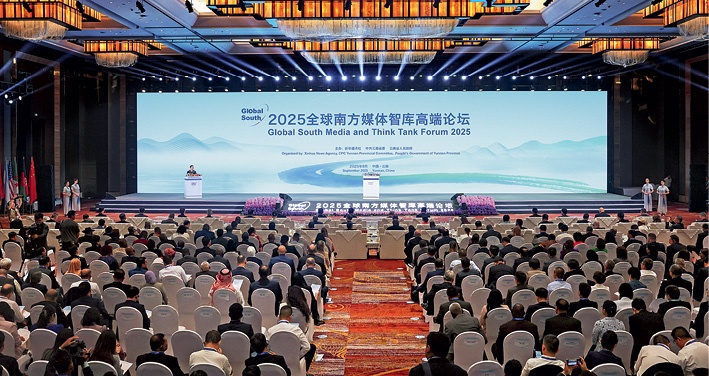
Themed “Empowering Global South, Navigating Global Changes,” the Global South Media and Think Tank Forum 2025 opens in Kunming, southwest China’s Yunnan Province, on September 6, 2025.
In 2021, China launched the Global Development Initiative (GDI) to inject new impetus into the UN’s 2030 agenda with over 80 countries joining the associated Group of Friends. In support of this initiative, it has established the Global Development and South-South Cooperation Fund and launched a further phase of the FAO-China South-South Cooperation Trust Fund.
However, while the GGI gained support from nearly 160 countries and international organizations on its introduction, it has attracted skepticism from the major Western powers. Beyond their zero-sum belief that improved lives in the developing world must mean losses for populations in the West, there is a fundamental misunderstanding of the GGI stemming from culturally bound notions of international governance.
Since 1648, when the Peace of Westphalia ended Europe’s Thirty Years’ War, if not before, Western thought has prioritized the interests of the nation state. Additionally, neo-realist ideas and social science teach that international relations entails largely unfettered competition for predominance among nation states. For some advocates of neo-realism, any attempt at global governance poses an unwelcome threat to national interests.
Hence, Western commentators and politicians are prone to expect the actions of all governments to be driven by ulterior, self-interested motives. Moreover, given that Western countries have for more than 80 years exploited international governance institutions to further their own interests, it lies beyond imagination that China could have established the GGI for altruistic reasons.
Chinese political theory is very different, as has recently been explained by Professor Zang Zheng from Soochow University. Of particular importance is the concept of “tianxia,” dating from the Western Zhou Dynasty (1046-771 B.C.) and translated as “all under heaven.”
Confucian thought binds the individual (ren), family (jia) and state (guo) together through mutual obligation, with familial duties and expectations – filial piety (xiaoshun) – infusing political ethics.
Moreover, the foundational Confucian classic, The Great Learning, places tianxia above both state and family. Government is therefore obliged to take responsibility not only for national affairs but also – in contrast to Western ideas – to prioritize the welfare of all under heaven. Tianxia, therefore, speaks directly to the GGI aim of “a community with a shared future for humanity.”
Tianxia became the ultimate source of legitimacy for China’s ancient rulers. Under imperial China’s tributary system, rulers had a duty to uphold universal peace rather than to pursue territorial and hegemonic dominance. Imperial homogeneity was based on culture rather than race or ethnicity, and there was generally no attempt to impose a singular form of governance or universal norms.
This policy of “harmony without uniformity” (he er butong) differs markedly, as Professor Zang notes, from the West’s attempt to impose a normative, rules-based world order on all nations. While not requiring pure altruism or the denial of national self-interest, “he er butong” replaces a “winner takes all” mentality with the possibility of “win-win” solutions.
It would be essentialist to suggest that modern Chinese foreign policy is entirely governed by ancient traditions. Even so, these concepts are explicitly drawn upon in the GGI white paper.
Regrettably, Chinese concepts can become irretrievably altered when viewed through a Western lens. An example is provided by the newly published book China’s Global Strategy Under Xi Jinping by Professors Steve Tsang and Olivia Cheung.
Blinkered by Western thought, they invent the concept of “Sino-centric party-state realism” to describe China’s foreign policy. They redefine and distort tianxia, placing concern for global welfare as the lowest priority. Additionally, they opine – based on belief not evidence – that China’s goal is “to discredit liberal norms and U.S. leadership … to transform the liberal international order into a Sino-centric one.”
With these imaginings to the fore, Tsang – who is director of the SOAS China Institute in London – insists in a postscript to the book that “to prevent a majority of UN member states from supporting China’s efforts to transform the international order,” the West “must make their offer more appealing than China’s, … putting the interests and welfare of people in the Global South high on the political agenda.”
The capitalist West’s failure to do this in more than 80 years reinforces the logic of the GGI that places the global common good above national self-interests. In this regard, one historical precedent is demonstrably better than another. 

ROBERT WALKER is professor emeritus and emeritus fellow of Green Templeton College, University of Oxford. He is a professor at the Jingshi Academy of Beijing Normal University and also a fellow of the Royal Society of Arts and the Academy of Social Sciences in the U.K.