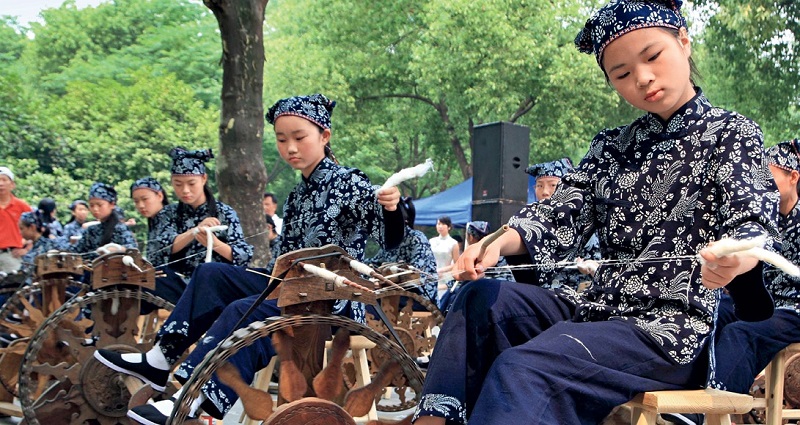
Girls dressed in traditional costumes operate Huang Daopo’s improved spinning wheels, showcasing a centuries-old cotton-spinning craft.
In the late Song Dynasty (960-1279), Huang Daopo, a woman from Wunijing in Songjiang (a town in present-day Shanghai), traveled all the way to Yazhou on Hainan Island. There she learned textile techniques from local Li women. More than 30 years later, she returned to her hometown with the hard-earned expertise and went on to become a legend in China’s textile industry.
Combining what she had learned with local production practices, Huang reformed cotton textile tools and techniques.
She created a complete handmade cotton textile process from ginning to spinning and weaving, which was among the most advanced of its time and generated enormous productive capacity. As a result, her hometown gradually became a national center of textile industry.
The impact was profound. For centuries, ordinary Chinese had relied on hemp clothing, which offered little warmth; while silk remained a luxury few could afford.
The efficient cotton production changed this, making warm, affordable garments accessible to common people for the first time. The craft also gave rise to a new industry and stimulated local economic growth. Most notably, it elevated women’s status both within the household and in society at large. From Shanghai, it spread rapidly across China and was later introduced to Japan, Korea, and countries throughout Southeast Asia.
At the heart of Huang Daopo’s contribution lay a spirit of innovation. She replaced the laborious practice of removing cotton seeds by hand with a mechanical gin; lengthened the bow used for fluffing cotton, giving it stronger and more powerful vibrations; and devised new weaving techniques that made it possible to produce a rich variety of patterns and designs. Her most celebrated invention was the three-spindle spinning wheel. By transforming the traditional single-spindle, hand-operated wheel into a foot-operated device with three spindles, she enabled one person to spin three threads simultaneously.
With the onset of industrialization in the 20th century, however, demand for this handcraft began to dwindle. To protect this time-honored tradition, the craft was inscribed on China’s first national list of intangible cultural heritage in 2006. In the modern era, its artistic, cultural, and historical value has come to the fore. In recent years, Shanghai has established training centers where veteran artisans serve as instructors, and schools have introduced programs that give students a firsthand experience of the craft’s enduring charm.